
Are Missouri Busted Mugshots Public?
Usually yes, though not through one shared website. The answer depends on who holds the record. Missouri's Sunshine Law makes agencies keep incident, investigation, and arrest records. Incident and arrest reports are generally open. That openness does not force a sheriff to post every booking photo online. The image may sit inside an arrest file. Or it may live in another system or face a legal limit. So ask the arresting agency for the specific photo and its record. A third-party copy can point you toward the right file. But it is not the official one.
Missouri opens arrest reports as a rule. Photo access still varies. It depends on the record and its custodian.
The Revisor's text of § 407.1150 controls the pay-to-remove rule described below.
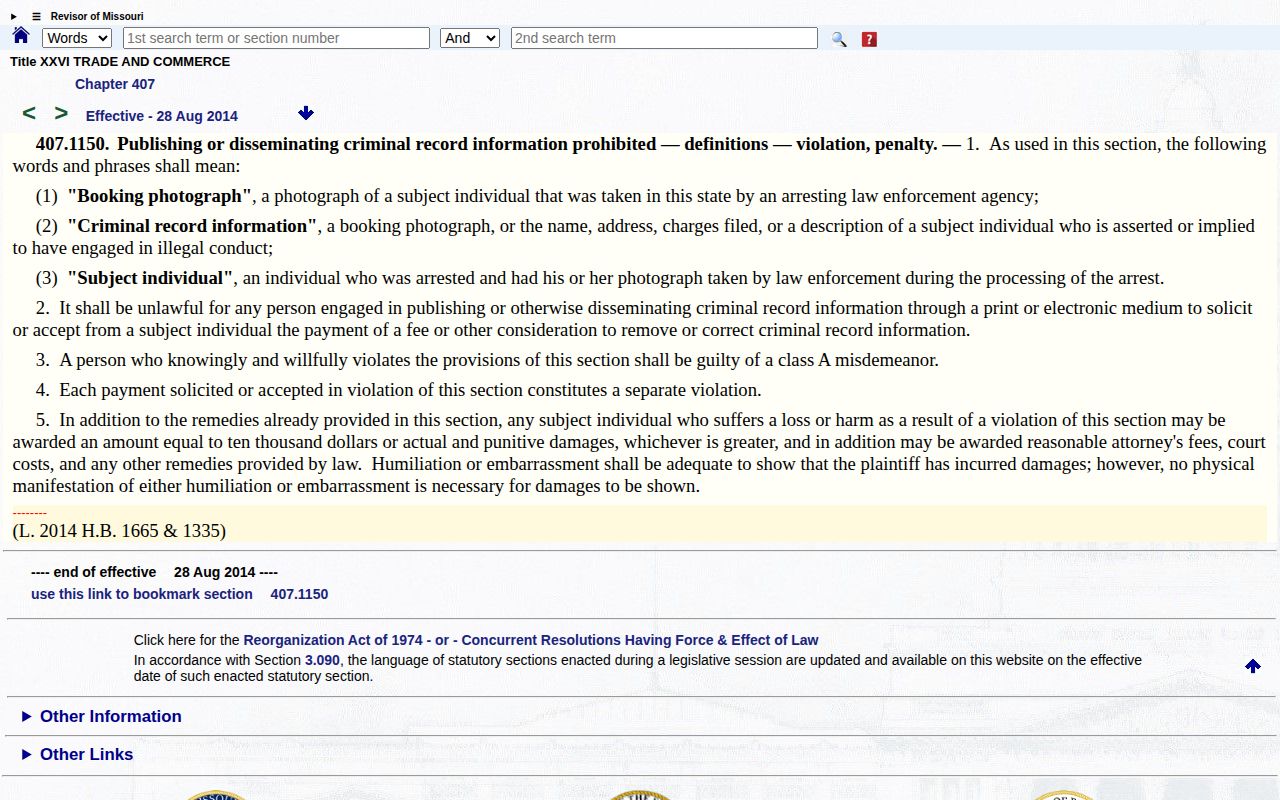
The page displays the enacted language that controls Missouri's specific payment-demand rule.
What Missouri's Busted-Mugshot Law Bars
Missouri passed § 407.1150 in 2014. House Bills 1665 and 1335 carried it. The effective date was August 28, 2014. A booking photograph is one taken in Missouri by the arresting agency during processing. The broader term, criminal record information, covers the image, identifying details, charges, and a description of alleged conduct. The subject individual is the person arrested and photographed.
What the law bars is the shakedown. Publishing the material is not the offense. The violation is soliciting or accepting payment or other consideration from the subject to remove or correct it. A knowing and willful violation is a class A misdemeanor. Each payment is a separate violation. Civil relief runs to the greater of $10,000 or actual and punitive damages. A court may also award attorney fees, costs, and other relief. Humiliation and embarrassment alone can establish loss.
The law bans no publication and sets no universal free-takedown deadline. Early bill drafts talked about favorable outcomes, but the enacted text targets payment demands. A St. Louis Circuit Court petition in Green v. Tauk alleges a dismissed arrest stayed online. A pleading is not a court finding. No published Missouri appellate decision squarely construes § 407.1150 yet.
Where Missouri Busted Mugshots Appear
Missouri runs no single booking-photo feed. Christian County's current inmate list shows photo fields. Benton County splits its roster into current and released views. Clay County takes a text-first approach, and its media guidance limits mugshot release. Plenty of counties post no roster at all. So a photo may be public or available on request, but access is far from uniform.
MODOC, the Department of Corrections, tracks active supervision only, covering probation and parole while leaving out discharged offenders. Its public workflow shows no photo field, and restricted photos stay private. A Sunshine Law request handles other state records. County booking photos belong with the arresting agency.
Missouri Case.net shows public cases and dispositions. Search by name or case number and confirm the filing court and charge, asking the clerk for a full or certified file if needed. A blank result may mean no charge, a different court, or a restricted case.
- Choose the county. Check its official roster for a person who may still be in custody; the Missouri County Directory routes to each locality.
- Request a missing photo. Ask the arresting agency for the image and report, including if the person was released.
- Verify the outcome. Check Case.net for a disposition and MODOC for active state supervision; neither replaces a county photo record.
The statewide Missouri busted-mugshot search path shows how local rosters and record requests fit together. The MODOC mugshots page covers the corrections lookup.
How to Request a Missouri Booking Record
Start with the custodian. That is the agency holding the arrest record. Under § 610.023, a request is due as soon as possible. The deadline is the end of the third business day, absent reasonable cause for more time. Any delay needs a written explanation plus the earliest expected date. If access is denied, ask for a written reason citing the law. That reason is due within three business days. Give the name, booking date, agency, and record type. Ask for the arrest report, booking sheet and photograph, booking number, and release date. Also request the final disposition, if held. If another custodian holds the photo, ask where to send it.
- Find the custodian. Start with the arresting police or sheriff's office.
- Name the records. Give the name, date, agency, and photo or report sought; request an electronic copy if available.
- Track the request. Ask for an estimate, answer clarification, and keep any written denial.
Section 610.026 sets the price tags. Paper copies run ten cents a page. Labor for duplication gets billed at the average clerical rate, and research time or special copies can add more. An agency may also demand its money up front. On the other hand, a request that serves the public interest can qualify for a fee waiver, and the office decides that case by case.
When Missouri Arrest Records Close
Open does not mean everything shows. Under § 610.100, an arrest report generally closes when no charge is filed within 30 days, though its disposition portion stays accessible. Investigative reports follow separate rules. So do mobile-video recordings. Both can remain shut while an investigation is active. When you ask for a photo, name the photo itself, since a missing web roster does not settle whether the arrest report is open.
Section 610.120 draws a clear line between closed and destroyed. Closing only limits public access. The person named keeps access, along with other authorized users, and the agency may remove, retype, or redact entries. A record can therefore vanish from public search yet still exist somewhere.
Juvenile records get stricter shielding. Section 211.321 generally closes juvenile court and social records and keeps peace officers' records on children apart from public files, subject to statutory exceptions and court orders. Serious-offense and transferred cases can shift access. Once a child turns 18, the juvenile court may destroy social histories and seal official files under a best-interest test. Never identify a child from an adult roster. Police records after a suspended imposition stay open through probation, then close on successful completion.
What Expungement Changes for Mugshots
A dismissal is not a clean slate. Under § 610.105, a nolle prosequi, dismissal, acquittal, or completed suspended imposition of sentence generally closes official records. The judgment, order, and final prosecutor action remain on file as disposition records. A favorable outcome does not erase each online copy.
Section 610.122 allows expungement for certain arrests. That covers arrests built on false information or without probable cause. It also covers arrests followed by no charge. Some eligible outcomes without a suspended imposition of sentence qualify too. Certain dismissed or not-guilty traffic matters qualify too. Conditions include no pending civil action about the arrest. A court order is still required.
The broader § 610.140 petition is filed where the case was charged or the person was found guilty. Its current form dates to January 1, 2025. Name each known custodian, from the arresting agency and Highway Patrol to the prosecutor and court. The general wait is three years after an eligible felony disposition. Misdemeanors, municipal offenses, and infractions wait one year. An arrest-only petition may be filed after 18 months. That applies if no charge came and no misdemeanor or felony conviction occurred during that period. Class A and dangerous felonies are excluded. So are sex-registration offenses and other listed categories. The lifetime cap generally allows three qualifying misdemeanors or ordinances and two felonies, with infractions treated separately. File with the current Missouri Courts forms. The court generally must issue an order or dismissal within six months.
Automatic expungement under § 610.141 takes effect August 28, 2026. Automated processing begins when technically feasible, and no later than January 1, 2027. Only specified electronic convictions qualify. That includes qualifying controlled-substance possession and paraphernalia offenses. Sole-charge limits apply. Class A felonies, a new disqualifying conviction, outstanding arrests, or pending misdemeanor and felony charges bar the route. Waits run one year after a qualifying misdemeanor disposition and three for a felony. The repository screens weekly, updates MULES, and notifies the court administrator. Coverage reaches qualifying electronic records retroactively. But a missed case must go by petition under § 610.140. Lifetime caps also combine with that section's limits.
Destruction is a different animal. Under § 610.124, a record expunged through the § 610.123 arrest-petition process is destroyed. A permanent-book entry is blacked out instead. Missouri electronic entries come out. The repository even asks the FBI to expunge its copy. The broader § 610.140 petition instead closes named official records under § 610.120. Neither route reaches every private copy or search result. Send each publisher the signed order and the exact page address.
| Record path | What changes | Next step |
|---|---|---|
| Closed or sealed record | Public access is restricted; closure does not destroy the record. | Ask the custodian what was redacted or removed. |
| Arrest expungement | Under §§ 610.122, 610.123, and 610.124, an order can require destruction. | Name each holder; contact private publishers separately. |
| § 610.140 petition | Named official records close under § 610.120; eligibility and timing limits apply. | Name known agencies, courts, and repositories. |
| § 610.141 automatic route | Qualifying electronic conviction records close; processing has a technical deadline. | Confirm status; petition under § 610.140 if missed. |
| Private page or search result | An agency order does not change copied pages. | Request a free correction, then refresh stale results. |
Free Missouri Busted-Mugshot Corrections
Start with the official fix. Send the arresting agency or named custodian the order, case number, and record description. Then ask whether its public system and repository were updated. A private edit leaves other copies alone.
Busted Newspaper's Missouri pages vary by county. So do their sources. The free request form accepts documents for errors, dismissals, expungements, seals, or not-guilty results. No statewide deadline or guaranteed result is stated.
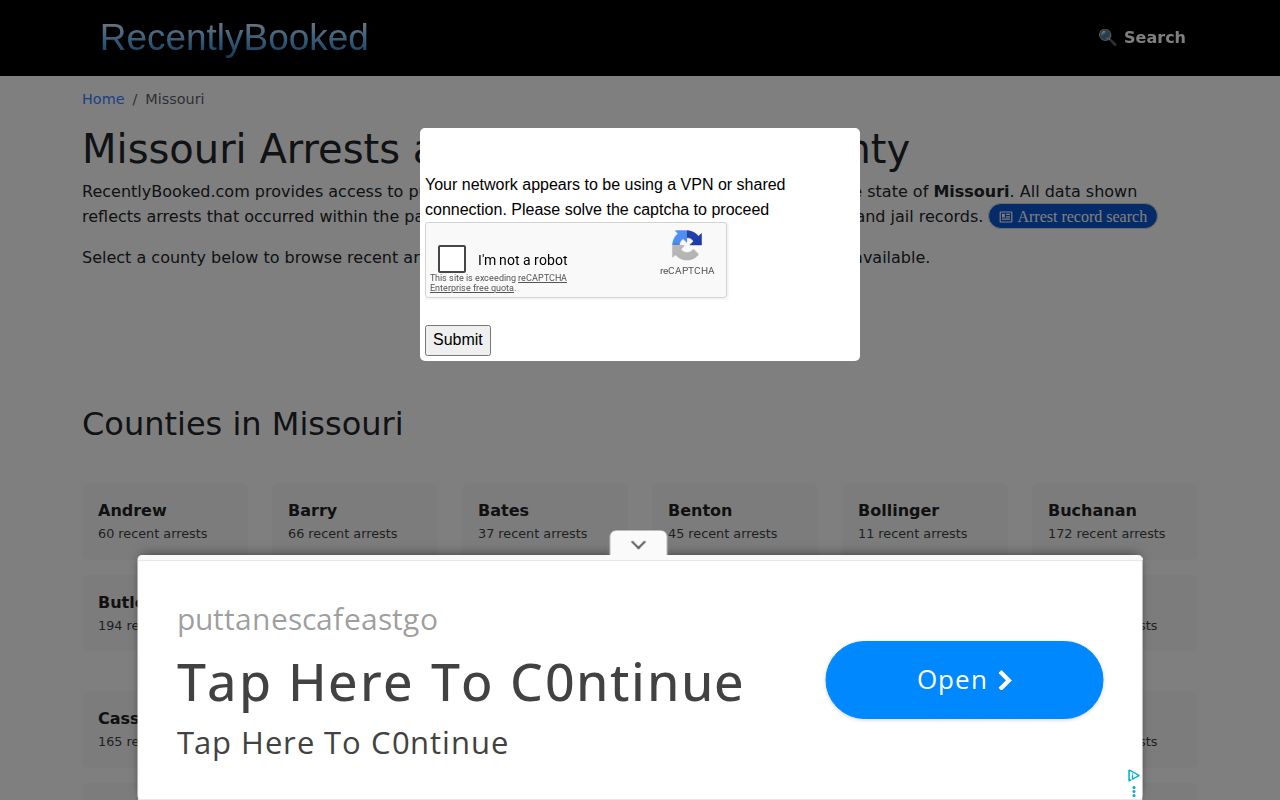
RecentlyBooked's Missouri listings differ county to county too. Removal there is free. Its policy charges nothing to remove, suppress, or modify listings, and it reviews dismissed, expunged, sealed, wrong-person, duplicate, juvenile, incorrect, or outdated entries. Email the listing URL, name, arrest date, state, county, reason, and papers to info@recentlybooked.com. Accurate current public records ordinarily stay up unless a listed category applies.
The RecentlyBooked Missouri navigation shows county links. It is not a complete official roster.
Mugshots.com's Missouri index blends current and historical busted-mugshot listings in one private collection. Its corrections policy is generous on price. Updates and removals cost nothing when you send signed proof. Qualifying grounds include expungement, sealing, restriction, identity theft, death, or a no-information outcome. The site prefers the record ID with each request. It allows favorable dispositions to be updated rather than deleted. It also quotes up to ten business days for processing, without promising an outcome.
The Mugshots.com Missouri index is a private archive, not an agency record.
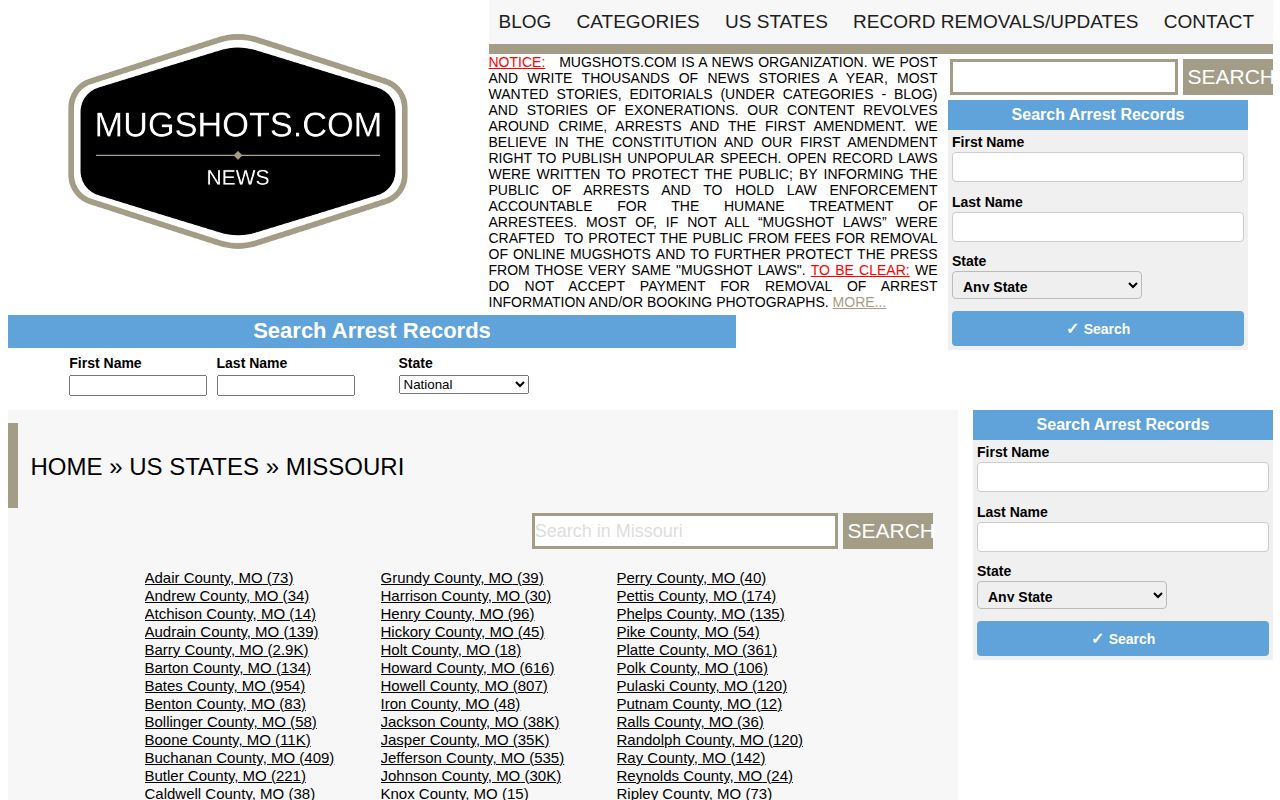
The screenshot shows a private publisher's state index, which remains secondary to the agency record and court outcome.
Arrests.org's Missouri search has county links and a removal route on listing pages. It warns that an entry may not mean conviction and points readers to courts or prosecutors. No clear, comprehensive free-removal policy or time limit was found. Send the listing URL and official papers; a form is not an official ruling.
Mugshots.zone's Springfield page describes local coverage; no stable Missouri-wide index was verified. Its local form takes the URL and documents for errors, expungements, dismissals, seals, or not-guilty outcomes. It says review may take up to ten days. No fee is displayed, which does not establish a statewide free policy or guaranteed result.
The Springfield Mugshots.zone page describes a local subdomain and request route, not a uniform Missouri index.
One Springfield subdomain proves nothing about the rest of Missouri, so treat this as a local route rather than a standard county policy.
Fixing Stale Busted-Mugshot Results
Search engines lag behind reality. A stale title or thumbnail can linger after its source page has changed. Save the URL and your official disposition or court order first, and ask the source to fix its page. Once it does, file an outdated-result request with that search provider. The refresh only updates the listing, never the underlying record.
Newsrooms run their own correction desks. Send an accurate disposition with the story's address and ask the editor directly. An editorial update leaves the original court record untouched.
Keep copies of every request. Never pay anyone demanding money from a subject to fix or remove covered Missouri arrest information. Section 407.1150 doesn't erase every private copy.